Le Mans 24 Hours: Danger, beauty & hydrocarbon – why the race is more important than you realise

[ad_1]
In the thick forest next to the famous Mulsanne straight at Le Mans, you can hear the distant drone of the engines held in the tall trees. It’s a dream-like experience at night, a constant churn of bright headlights and raw sound.
In the oppressive heat of a Le Mans summer day, the soft moss saps energy from the air.
Mulsanne has been sanitised since Ferrari last raced here as a works team – two chicanes slow the pace to help reduce the chance of a car losing its downforce load and, as they have in the past, taking off like an aeroplane and landing in the trees.
It is 10 years since the race saw its most recent fatality when Dane Allan Simonsen crashed his Aston Martin at the corner preceding Mulsanne, Tertre Rouge. His car hit a tree behind the barrier, just minutes into the race.
“On every driver’s licence it says motorsport is dangerous,” Ferrari’s James Calado muses in the team’s huge hospitality suite.
“We realise the danger, but in all honesty the risk isn’t high if you compare it to bikes on the Isle of Man. It’s not even 0.1% of the danger of what those boys are doing.
“Occasionally bad accidents can happen – normally fluke. I don’t want to jinx it, but cars are super safe – you can have a big impact and the car will be fully intact.”
Motorsport has cleaned up its safety record since Le Mans’ grimy glory days. Given sustainable fuels still release particulates such as toxic nitrogen dioxide and electric cars soak up power from the grid, there is a way to go before the same can be said for its sustainability credentials.
“As a driver my job is to drive the car and do the best I can,” says Calado.
“I’m all for sustainability. It’s difficult to know what’s going to happen in the future. The whole world needs to make a difference and we will do everything we can to help.”
Calado, Britain’s most high-profile factory Ferrari driver since Nigel Mansell in the late 1980s, acknowledges the power that Le Mans has as a stage, both for a race and, potentially, for bigger questions that affect us all.
“It is magical,” he adds with a smile when talking about driving in the middle of the night. “The fans never go away… it’s three or four in morning and you can still see and smell the barbecues when you are in the car.
“You smell everything – the sparks when a car scrapes the ground, and we get dust in our eyes where the visor’s open.”
It’s an elemental experience. Tired drivers feel the aches, taste the dirt and smell the fumes.
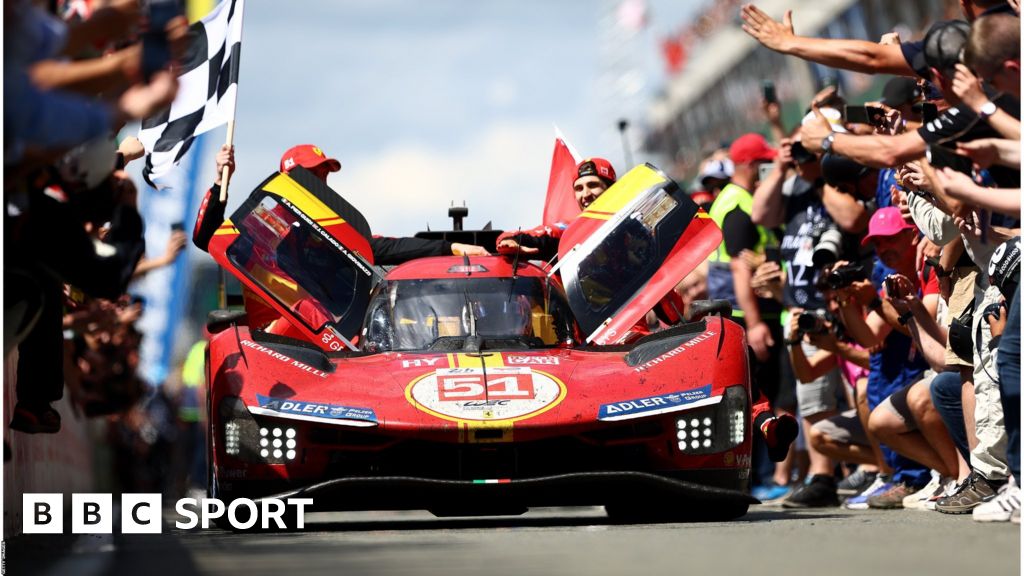
For Calado and Ferrari, the weekend also finished with the sight of the chequered flag and a landmark victory to cap off the marque’s comeback to Le Mans.
And the signature sound, for better or worse, remained the same as ever – the crackle of engine overrun.
Source link