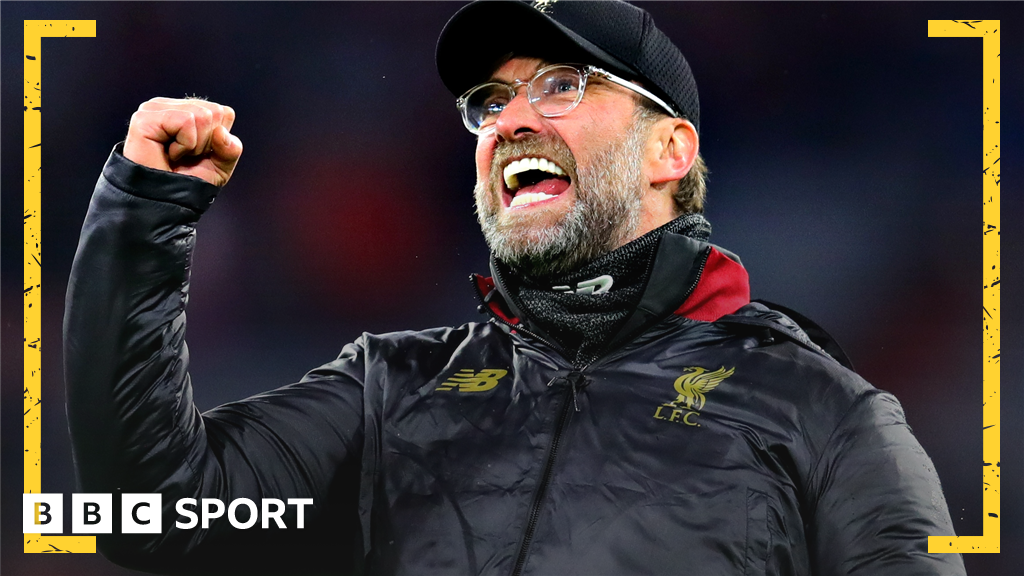
Liverpool win Premier League: Jurgen Klopp’s transformative role

[ad_1]
Gordon has the complete trust of principal owner John W Henry and chairman Tom Werner. While Henry may be the figurehead, Gordon is the most influential owner in many ways because he makes the crucial decisions along with Klopp and Edwards – whether it is a signing, contract renewals or extensions, even down to the recruitment of academy coaches.
Gordon has the final sign-off on major projects, such as the £60m extension of the Anfield Road Stand to take capacity above 60,000, and the new £50m training facility at Kirkby. But he is not simply the man who signs the cheques. Anfield insiders acknowledge his sharp football brain as well as business acumen.
He sees his role as empowering Klopp and Edwards to ensure the football operation flourishes. He has total trust and confidence in their judgement. The three are in constant touch daily, WhatsApp messages fly between all parties.
Edwards joined the club as head of analytics in 2011 and was appointed as sporting director in November 2016. In terms of public profile, he remains secretive and elusive, out of the public eye. He believes that helps him do his work under the radar to deliver what Klopp and Liverpool need.
Inside Melwood, the story is very different. Edwards is respected and admired, operating an open-door policy and having his own trusted staff such as head of scouting and recruitment Dave Fallows, chief scout Barry Hunter, and Ian Graham, Julian Ward and Dave Woodfine.
When Klopp signed a new contract in December, tying him to the club until summer 2024, he said: “I must highlight the role of our sporting director Michael Edwards in this journey so far. His input and collaboration has been just as important as anyone else’s in getting us into a position to compete for the game’s top titles.”
Edwards has his team. Klopp has his. Gordon empowers and discusses before signing off, and therein lies the method behind Liverpool’s brilliant resurgence.
One of the classic examples of how this triangle of power works came when, in Hong Kong on a pre-season tour in summer 2017, midfielder Philippe Coutinho effectively told the club that overnight he had become unhappy and wanted to move to Barcelona, who had just sold Neymar to Paris St-Germain.
Coutinho, despite his obvious brilliance, was actually regarded by some as a player Liverpool had come to rely on too much. When he did not perform, as in the 2016 Europa League final loss to Sevilla in Basel, the overall team suffered.
When the Brazilian duly made his move in January 2018, plans were in place to conclude two of the most important signings in the club’s recent history, following up the long-planned pursuit of Van Dijk with the £66.8m arrival of Brazil goalkeeper Alisson from Roma in July 2018.
Coutinho was not replaced, but acquisitions were made in other areas that pushed Liverpool to their current level.
In February 2017, Liverpool had drawn up their list of transfer targets that included the likes of Bayer Leverkusen’s Julian Brandt and Christian Pulisic, who was coming to prominence at Borussia Dortmund and is now with Chelsea. The name of Roma’s Mohamed Salah lurked elsewhere on Liverpool’s radar.
Salah was the deal that was done, with Klopp very happy to give much of the credit to the forceful opinions of Edwards that this was a potentially game-changing signing.
This cool, analytical, collegiate system is now the envy of Europe’s elite clubs and central to the plans that have brought the title back to Anfield after 30 years.
Source link