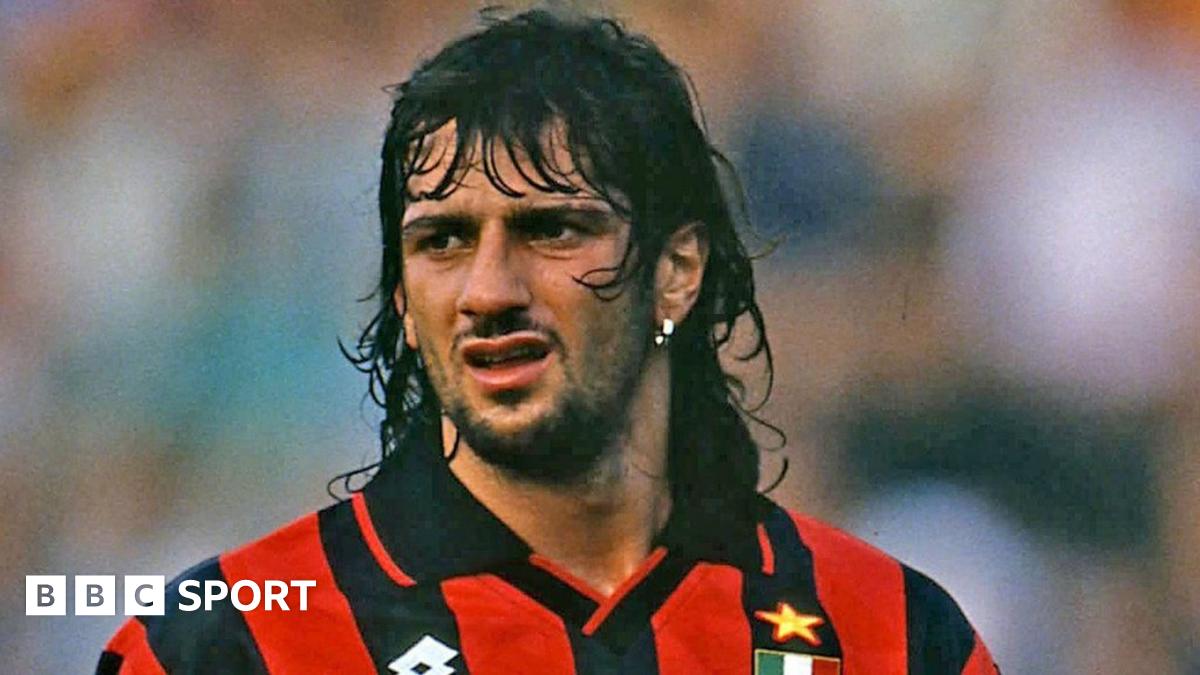
Gianluigi Lentini: The rise and fall of the world’s most expensive player

[ad_1]
By now Lentini was in a relationship with Rita Bonaccorso, the wife of the Juve striker Salvatore ‘Totò’ Schillaci.
Schillaci had been the break-out star of Italia ’90 but now his marriage, much like his career, was in terminal decline. Bonaccorso and Schillaci were engaged in a tit-for-tat game of betrayal, with Lentini cast as the man in the middle.
Following a pre-season tournament in Genoa, he climbed into his canary-yellow Porsche 911.
Bonaccorso was waiting impatiently in Turin and so he launched the car at breakneck speed along the A21 motorway. He got a puncture, pulled into a service station and watched, frustrated, as an attendant bolted on the spare.
Lentini roared back onto the road, but failed to understand that the skinnier wheel wasn’t designed to exceed 50mph, let alone the 125mph he was purported to have been doing.
A following truck driver watched on in horror as the car began to zigzag wildly across the carriageway. He leaped out of his cab to drag Lentini from the wreckage seconds before it caught fire.
He was put in an induced coma, but the Lentini who emerged was a shadow of the buccaneering footballer he had been. Save for a highly productive five-week period in early 1995, he hardly played for three seasons and scored precisely six league goals. Some speculated the coma had impacted his balance, others said his cognitive skills were diminished.
That’s probably true to some degree at least, but he was lucid enough when he married a beautiful Swedish model. Typical of this most untypical of footballers, he tied the knot in his old parish church in Carmagnola. There were no journalists and hardly anyone from his footballing career received an invite.
As his form and fitness deteriorated, the line went that, for all that Lentini liked playing football, he’d never really embraced it as a job. That maverick streak had been the perfect fit for Toro, where Mondonico’s promptings and the “new Gigi Meroni” schtick had suited just about everybody.
In Milan, however, they demanded professional rigour.
The club retained a psychologist, and measured the players’ reaction time and physical parameters. They sought to quantify performance, deploying objective data to assess subjective performance.
It was a far cry from Mondonico’s muck-and-nettles approach and the latitude Lentini had been given in Turin.
The story went that he liked the discotheque much more than the training ground, and the affair with Bonaccorso and his car crash were symptoms of a deeper malaise. Lentini was ill-suited to football’s modern, more professional era, When his contract expired, Milan couldn’t wait to get him off the books.
By now Mondonico was working down the road in Bergamo, coaching Atalanta. He offered a way out and, under him, Lentini became something like the player he’d been at Toro.
He was still only 27 when Arrigo Sacchi recalled him to the Italy team in November 1996, and hope sprang eternal. Yet at the season’s end, Lentini saw fit to rejoin Serie B Toro.
That finished him as an international footballer, but signalled the start of a nomadic, rackety coda to his career.
After a promotion and immediate relegation with Torino, Lentini hitched another ride alongside Mondonico at Serie B Cosenza.
Mondonico, he said, was the only coach capable of making him angry on a football pitch and, as the son of a Sicilian migrant family, he felt the pull of the south. Besides, the weather down there suited him too.
When asked whether he, less than a decade after becoming the world’s most expensive footballer, felt chastened by playing in front of 3,000 fans in a footballing backwater, Lentini seemed genuinely nonplussed.
Football was football, he replied, regardless of where you played and who it was against. When Cosenza were demoted to Serie D for financial irregularities in 2004, Lentini stayed on. He did so because they asked him to – and because they were nice people.
He went home to Piedmont in 2004 and, aged 35, an old friend asked him to turn out for local amateur team Canelli.
On the way to training one evening he called in on Diego Fuser, another graduate of the Toro school of excellence. As professionals they’d gone their separate ways and hadn’t played together for 15 years.
Fuser hadn’t been as gifted as Lentini, but few had. Instead he had enjoyed success with AC Milan, Lazio, Parma and Roma, as well as representing Italy 25 times. Their friendship, formed when they were starry-eyed teenagers, had endured.
Fuser’s eight-year-old son was suffering from an incurable illness and the camaraderie acted as a balm of sorts. Fuser, too, was reminded that football’s greatest virtue is that it’s only a game, and the two of them set to work once more.
Canelli earned promotion to semi-professional Serie D in 2006, and Lentini and Fuser carried on playing together in the lower leagues beyond their 40th birthdays.
Source link