Sheriff Tiraspol: Champions League team from an unrecognised state

[ad_1]
“It was also hoped that teams from Russia and Ukraine would come and use the club’s facilities and that that would help create big football rivalries,” says Lulenov. “But it isn’t the way it’s turned out. The football club is run at a massive loss.”
Instead of transfer fees, the current squad have shown their value for Sheriff on the pitch. Of the XI that started their Champions League play-off first-leg win against Dinamo, 10 had been signed since the end of the club’s previous European campaign 12 months earlier.
Sheriff have rarely relied much on local talent, but a recent relaxation in the Football Federation of Moldova’s regulations regarding homegrown quotas has freed the club up to pack out their squad with signings from abroad. In 2019, the club had 11 Moldovan passport-holders on their books; this season, it’s just six. Two of them are backup goalkeepers, while another two are fringe players fresh out of the club’s academy.
Instead, the team is a patchwork of nationalities and cultures. The Champions League squad features players from Malawi, Trinidad & Tobago, Uzbekistan, Ghana, Brazil, Luxembourg and Peru. Taken in the context of Trans-Dniester’s unusual political status, there is little sense in which Sheriff truly represent Moldova.
Speaking to ordinary people on either side of the Dniester river, the view seems to be that the partition of the country serves nobody but the political elite.
That is a position echoed by authorities in Ukraine. Yulia Marushevska, head of the Odessa regional customs division, said in 2016: “[The situation] is suitable for contrabandists, and for high-ranking officials in Chisinau and Kiev.
“This is a matter of political will, both for the Ukrainian authorities and for the Moldovan authorities.”
Since the crisis in Ukraine that began in 2014, there has been a tightening of border controls. In July 2017, a customs post, jointly operated by Ukrainian and Moldovan authorities, was set up at the border village of Pervomaisc-Kuchurgan.
The European Observatory on Illicit Trade (Eurobsit) estimates that 70% of the illegal trade passing through Trans-Dniester had previously entered and exited at this crossing, on its way to and from the Ukrainian city of Odessa.
Meanwhile, a 2014 free-trade agreement between Moldova and the European Union included Trans-Dniestrian businesses in its scope, and exports have since swung dramatically away from Russia and towards Moldova and the West.
It seems despite 29 years of deadlock, there are signs of greater co-operation.
“This conflict is not totally frozen, rather it is a conflict of frozen solutions,” says Octavian Ticu, a historian and former minister in the Moldovan government.
“Moldovans have interests with Trans-Dniestrians, they deal well together in business.”
Outside of the capital, football does what it can to soothe the horrors of the past.
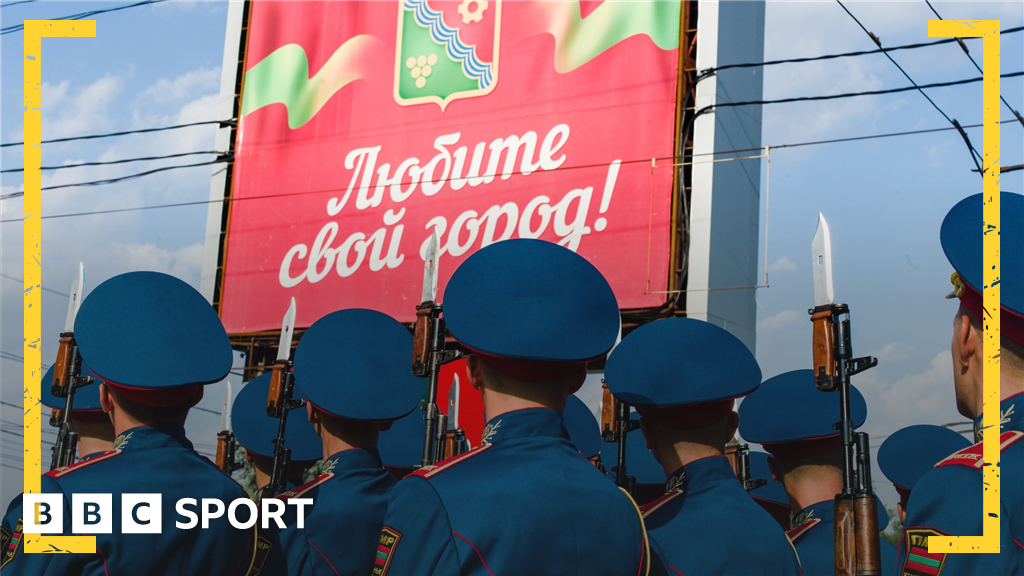
In the town of Bendery, just a few kilometres inside the Moldovan border but under Trans-Dniestrian control, a military roadblock manned by khaki-clad soldiers beckons cars to a crawl as they flow in and out of town.
A mounted tank points its barrel triumphantly at the overcast sky. Along one side Cyrillic lettering bears a call to arms: За родину! – For the homeland!
Situated on the banks of the Dniester, this is a city of the crossfire.
Alexandru Guzun was due to play for Bendery club FC Tighina against FC Constuctorul the day a simmering conflict broke out into war. The date was 2 March 1992.
“Can you imagine the shock of arriving in a city you know well and seeing bombs exploding in the streets?” he says.
Guzun was due to meet with his team-mates at a hotel before travelling together to the club’s Dynamo Stadium home ground. That isn’t the way it worked out.
“The hotel was right on the river. Because of where it is located, with Tiraspol only a few kilometres one way and the Moldovan soldiers coming from the other, we were physically in the middle of the fighting.”
Once inside the hotel, it quickly became clear that there was no way out. With bombs and shells exploding around them, Guzun and his team-mates took the only route open to them – downwards.
“We took everything we could down to the basement. Everything we needed to live. We would take it in turns to go up to the first-floor hotel restaurant to get supplies and take them back down for everyone. We were trapped there for three days,” he said.
“On the second day of the siege, some pacifists who were on neither the Moldovan nor the Trans-Dniestrian side, came to the hotel. They erected a white flag from the top floor. These guys lived underground with us.
“We found out since that an agreement was reached between the two parties for a ceasefire to allow people inside the hotel to escape. I don’t believe that could have happened without the guys who came with the white flag.
“But we still had to make it from the hotel over the bridge. Just because a ceasefire has been agreed, it doesn’t mean no-one will shoot at you. Nobody would have investigated. The bridge was full of bullet holes.”
Guzun left FC Tighina at the end of that season to move to Ukraine. Most of his team-mates followed. It took years for the city to recover from the distress suffered in the first half of 1992. A ceasefire in July that year brought the conflict to an end.
Back in Tiraspol, FC Sheriff’s power is so entrenched they are unlikely to be surpassed by their impoverished rivals in the Moldovan league any time soon.
Last season’s Divizia Nationala title was wrapped up with 32 wins from the 36 games and just a single defeat, as the team romped home by a 16-point margin.
A stale, uninteresting dominance prevails in the league. The hope now is that the Champions League and the visits of Real and Inter will inject some much-needed excitement into the predictable spectacle of Sheriff’s annual title processions.
“The football club will never collapse,” says Lulenov. With a TV-rights windfall from Uefa pending and the on-going backing of the Sheriff behemoth, he is probably right. But still the roads in Tiraspol are cracked.
“Peace and prosperity, that’s all we want,” says Smolensky, swerving to avoid another gaping hole in the ground.
“When you have that, everything else takes care of itself.”
Source link