
The Bollywood record label that conquered YouTube

[ad_1]

 Getty Images
Over the last few months, India’s biggest record label T-Series has become an unstoppable presence in the world of online music.
The Mumbai-based company has become, by far, the most-viewed channel on YouTube with over 60 billion views. It also recently ousted Swedish vlogger Felix Kjellberg – known by his alias Pewdiepie – as the most-subscribed YouTube channel, and it is a whisper away from being the first to break through the 100 million-subscriber mark.
The way in which T-Series has reached figures that the likes of Justin Bieber and Taylor Swift can only dream of involves a mixture of being in the right place at the right time, and some good old-fashioned marketing tactics. Understanding this helps explain why T-Series’ rise is unlikely to slow anytime soon.
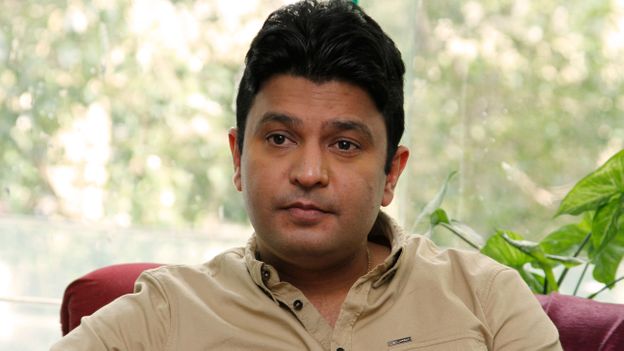
Getty ImagesFrom across the table, I overhear Bhushan Kumar, chairman and managing director of T-Series, discuss an unfinished song with a well-known Bollywood actor over the phone. Bhushan apologises sheepishly for the interruption, and we resume from where we left off. There are a few more such calls during our conversation, and each of them involves discussing a work-in-progress song. “I finished working on two other songs today, even before this interview,” he says.
According to music industry veteran Atul Churamani, it is such attention to detail that makes T-Series so successful at what it does.
“Bhushan’s approach to the business is really hands on,” he says. Churamani is the managing director of Turnkey Music and Publishing, a company that publishes independent music, curates music events and mentors artists. “When Bhushan stepped in after his father’s death, he took the company to the next level. As far as the [Indian] music industry is concerned, he’s the biggest industrialist we have.”
The rise of T-Series is familiar to most Indians. Bhushan’s father, Gulshan Kumar, came from humble origins, and in the early 1980s he built the parent company, Super Cassettes Industries, from scratch. The label initially made a name for itself from selling devotional content in the form of hymns and prayers, and pirated film music. As the company grew, it began producing film music for Bollywood blockbusters. In 1997, when the Mumbai underworld assassinated his father, Bhushan took over the reins at the age of 19.
According to industry estimates, T-Series’ annual revenue is $100 million, with a market share of 70-80 percent. Outside India, it’s T-Series’ sudden and rapid rise on YouTube that has garnered the most interest. It has expanded its YouTube subscriber base from 18 million in 2017 to almost 100 million within the space of two years.
Kumar says that rising up the YouTube ranks was not a deliberate plan to begin with. “We didn’t really make a focused attempt to reach number one,” he says. It was only after persistent coverage in the international media, from his team and from YouTube itself, did he realise the enormity of the development. “Honestly, around this time last year, I wasn’t even aware – let alone bothered – how high we ranked on YouTube,” says Kumar.
Kumar shies away from figures, but he says that 20% of T-Series’ total revenue comes from YouTube. And that about 65-70 percent of the channel’s subscribers are from India.
To understand T-Series’ success, you have to understand the dramatic shift in internet access in India over the past two years. From 2010, T-Series started posting trailers and music videos onto YouTube, with modest success. But then Reliance Jio, launched by India’s richest man, Mukesh Ambani, disrupted the telecom market when its mobile services hit the market in late 2016. This brought cheap internet to the masses. It forced heavyweights like Vodafone and Bharti Airtel to drastically reduce the price of their data plans.
The result is that more than 500 million Indians are now connected to the internet, making India the world’s second-largest market after China. The effect has been profound. There are more than 16 million new connections per month, almost all on mobile phones. The average Indian phone user now consumes more mobile data than most Europeans. It is now a common sight to see rickshaw drivers and hawkers, who may not have running water or electricity in their homes, watch YouTube songs on their smartphones.
“We call it the Jio-effect as it catapulted the consumption of Indian content, and helped platforms like YouTube penetrate the Indian interiors,” says Neeraj Kalyan, president, T-Series.
 Getty Images
T-Series has been perfectly placed to capitalise on this Jio-effect. The company has over 160,000 songs and 55,000 music videos in its archive, giving it a massive first-to-market advantage over younger rivals. Bhushan recently told Quartz that he runs his digital team like a boutique firm. “We do not believe in keeping 100 people, instead, we have a team of 20 running our digital business,” he said. “It is led by a bunch of our senior-most people.”
Bhushan insists that you can have all the free data you want, but you can’t build an audience without understanding what a good melody is. “My father would make music keeping public tastes in mind. I have inherited this from him,” Bhushan says, referring to this quality as ‘ear-sense’. “We can judge the pulse of a song and match it with our listeners’ sensibilities,” he says. “I think we do this extremely well, and it helps us a lot.”
Genres may adapt with the times, but melody and lyrics stay the same. “I call this the packaging of a song,” says Bhushan. “Today, when we make remixes or remakes, we just change the packaging. It always works. We are more than 90% accurate in gauging what people will like.”
Increasingly, T-Series’ YouTube hits are also independent singles. For instance, Lahore, a pop song by Guru Randhawa – a 27-year-old Punjabi musician – has over 700 million views and is the most popular video on the channel. “We actually released more non-film music than film songs on our YouTube channel, last year,” Bhushan says.
 YouTube/T-Series
The flame war with Pewdiepie has helped further drive success. Pewdiepie and his supporters have said T-Series’ success highlights the growing corporatisation of YouTube, and have responded with everything from diss tracks to hacking the Wall Street Journal website and thousands of printers across the world, urging people to subscribe to Pewdiepie. T-Series responded to the comments by launching the #BharatWinsYouTube campaign, using nationalism to seek more subscriptions from Indians.
The result is that T-Series has had more interest outside India, seeing growth in countries where people were not watching their channel. “It’s a classic David-vs-Goliath story with a Guy-Fawkes syndrome,” says Luke Kenny, an Indian music columnist and actor. “It makes for good entertainment and great business for all.”
According to Neeraj, this tirade against his company might have started out as fun, but it is no longer in good taste. “Felix (Pewdiepie) is a social influencer with a globally humungous fanbase. I advise this young, energetic lad to use his energy and influence towards creating positivity and a sense of social responsibility among his fanbase, rather than making videos that create an invisible divide,” he says.
Bhushan says T-Series will respond to Pewdiepie by making more music. “It’s what I do every day.”
If you liked this story, sign up for the weekly bbc.com features newsletter, called “If You Only Read 6 Things This Week”. A handpicked selection of stories from BBC Music, Culture, Capital, Future and Travel, delivered to your inbox every Friday.
Source link