

[ad_1]

 The Metals Company
A new international treaty aims to support protection of the high seas – what will this mean for deep-sea mining?
On 5 March, the world reached what could well be a turning point for protection of the world’s oceans.
So what do these momentous developments for the ocean mean for the seafloor?
A momentous era for the seabed
Norway is set to become the first country to pursue commercial deep sea mining, as the country votes to allow the controversial practice in its national waters.
Companies will be able to apply to mine the seabed within an area 280,000 sq km (108,000 sq miles), under the proposal. The mining area sits between the coast of mainland Norway, the Norwegian archipelago Svalbard, Iceland and Greenland.
A period of mapping, exploration and environmental surveys would be carried out before large-scale extraction would begin.
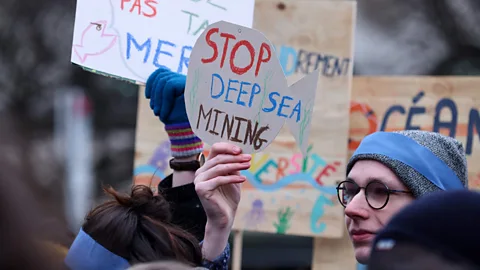
Deep-sea mining has been proposed – and rigorously opposed – for decades. While some argue the minerals found in the seafloor are a promising source of metals needed for technologies such as mobile phones and wind turbines, scientists have argued we don’t know enough about the ecosystems of the seafloor to guarantee that mining won’t cause irreparable harm.
Since 2001, 31 permits to explore the ocean floor with a view to exploitation have been granted by the International Seabed Authority (the United Nations body responsible for regulating deep-sea mining). In 2021, the Pacific nation of Nauru in Micronesia took one big step closer to deep-sea mining, announcing its intention to begin commercial exploitation of the seabed. That triggered an obscure “two-year rule” that gave the ISA a deadline to finalise its rulebook for environmental regulation.
The new High Seas Treaty could eventually have an important overarching influence in protecting the seabed, but it will take many months to be ratified and implemented. It’s the looming July deadline that matters most for deep-sea mining, says Minna Epps, head of the oceans team at the International Union for Conservation of Nature (IUCN). “That’s our window,” she says. “And it’s closing.”
A spokesperson for the ISA tells BBC Future that the authority shares the objectives of the High Seas Treaty, and “stands ready” to collaborate and implement its ambitious goals, though it is too early to say how the treaty will affect the deep-sea mining rulebook due in July.
 Getty Images
Much of the interest in deep-sea mining has focused on polymetallic nodules – potato-sized lumps rich in a combination of metals that sit on the surface of the deep ocean floor.
The test of time
The Clarion-Clipperton Zone, a large stretch of seafloor between Hawaii and Mexico, is particularly rich in polymetallic nodules.
One long-running experiment here simulated extraction of the nodules in 1989, and returned periodically to see how the ecosystem had changed before and after.
The researchers found that even 26 years later the ecosystem had failed to return to its previous state, and biodiversity in the area had reduced overall.
Mining proponents, such as Gerard Barron, chief executive of The Metals Company, argue these tests were more invasive than the techniques they use.
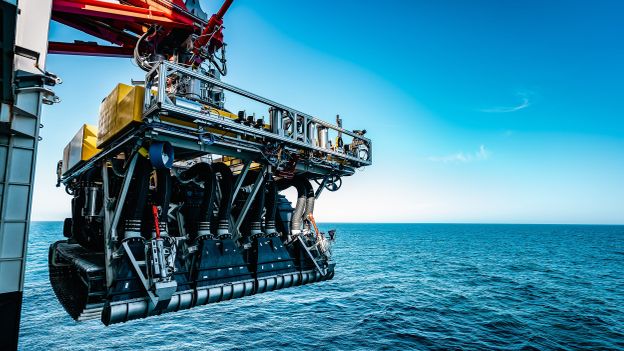
Techniques to obtain the nodules vary. Some involve using machines likened to “huge combine harvesters“, disturbing a layer of sediment as the nodules are collected. The plumes of sediment released by this activity could stretch for hundreds of kilometres and risk smothering animals, harm filter-feeding species and obscuring animals’ vision, according to the IUCN.
Especially for the species that live on the ocean floor, known as the benthic ecosystem, strong environmental regulation is hugely important, says Kirsten Thompson, lecturer in ecology at the University of Exeter in the UK. “Mining could irreversibly damage benthic ecosystems.”
For species living higher up in the water column, such as cetaceans, the impacts of mining are less well understood. “But, considering the myriad threats faced by marine ecosystem in general, regulation of human activities is vital to ensure biodiversity conservation and to preserve ecosystem functioning,” says Thompson.
There is also an immense quantity of carbon thought to be locked up in deep-sea sediments. When tiny organisms and bits of organic matter, from dead seaweed to whale faeces, fall to the ocean floor, some of the carbon that makes up that detritus, known as “marine snow”, falls out of the carbon cycle and rests in sediments for millions of years. That is, if it is left undisturbed.
“So it’s not just the direct disturbance of the sea floor and those precious, unique little species that are there,” says Epps. “It’s also about what would happen if you stir it up, and all that carbon is released again.”
Other researchers, such as Seaver Wang at the Breakthrough Institute in Berkeley, California, question whether stirring up carbon in the sediments would in fact lead to its release into the atmosphere. Until conclusive research is carried out in the field, it’s another question to add to the list of deep-ocean unknowns.
The proponents of deep-sea mining argue that to obtain the large quantities of metals that we need for green technologies like wind turbines and solar panels, as well as for devices such as mobile phones, we will need to use the ocean’s resources.
“Where should those metals come from?” says Gerard Barron, chief executive of The Metals Company, a Vancouver-based deep-sea mining firm. “We think unequivocally the right resource is polymetallic modules.”
He argues deep-sea mining could be carried out with less disturbance to ecosystems than land-based mining, which often leads to habitat destruction and generates large quantities of waste. (Read more about the environmental impacts of mining on land.)
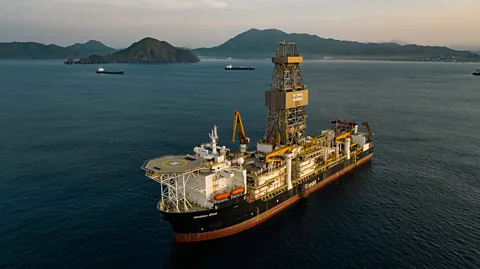
Barron’s firm carried out a test in November 2022 that extracted 3,000 tonnes of polymetallic nodules from the Clarion-Clipperton Zone.
One report by the US Geological Survey estimated that if deep-sea mining were to follow the path of fossil-fuel extraction at sea, then by 2065 the deep oceans could supply as much as 35-45% of our demand for critical metals.
“Strictly speaking, these seabed resources are not necessary to meet projected battery mineral needs in the EV and storage sectors,” says Wang. “Future needs for the next few decades could in theory be met entirely through extraction on land.”
Wang does, however, believe it is important to answer the question of whether deep-sea mining is less damaging to communities and the environment than land-based mining. “This has not yet been conclusively demonstrated,” Wang says. “I would personally advocate for more marine science research and pilot-scale tests to verify that the environmental impacts of nodule harvesting are low.”
 The Metals Company
“Considering the vast implications, both direct and indirect, and all the other consequences that we don’t actually know, because we don’t have enough knowledge, that alone points to [the idea that we] shouldn’t go ahead with deep-sea mining,” says the IUCN’s Epps.
Louisa Casson, who leads the environmentalist group Greenpeace’s campaign to stop deep-sea mining, believes that momentum from the High Seas Treaty “will inevitably spill-over” into the ISA’s upcoming deep-sea mining negotiations in Kingston, Jamaica. “This treaty is a monumental win for ocean protection and an important sign that multilateralism still works in an increasingly divided world,” says Casson.
The impact of the High Seas Treaty on ocean life could turn out to be profound, perhaps the greatest step in protecting the seas that the world has yet taken. But in the race to conserve life in the watery depths, this is only just beginning.
WATCH – The unseen man-made ‘tracks’ on the deep ocean floor:
An earlier version of this article stated that The Metals Company’s 2022 test retrieved three tonnes of polymetallic nodules. This has been corrected to 3,000 tonnes.
Source link